He Ran Away to Sea at Fourteen and Came Home to Paint America's Walls
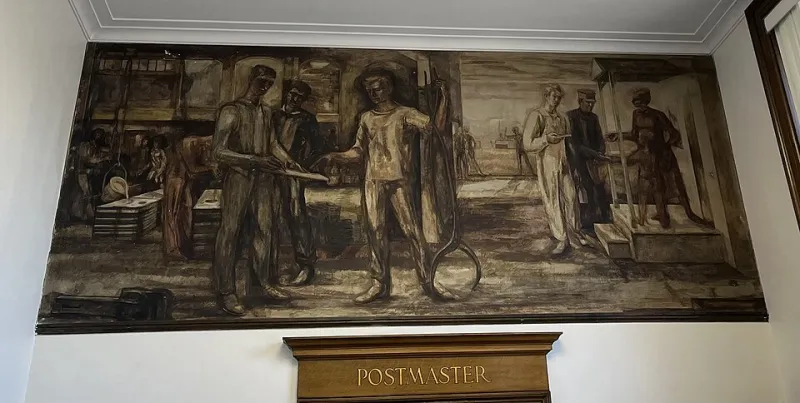
Photo: J. Passepartout, CC BY-SA 4.0, via Wikimedia Commons
He Ran Away to Sea at Fourteen and Came Home to Paint America's Walls
Somewhere in the archives of a maritime union hall in Baltimore, there is a crew manifest from 1931 that lists a deckhand named Thomas Aurelio Vance, age eighteen. He was fourteen.
The lie was not unusual for the era. The Depression had pushed thousands of boys toward the docks, and the merchant marine, perpetually understaffed and unsentimentally practical, asked few questions of anyone willing to work. What was unusual about Thomas Vance was what he did during the crossing: he drew.
In the margins of whatever paper he could find — cargo receipts, navigation charts, the backs of letters he never sent — he sketched the faces of the men he worked alongside. Filipino engineers. Norwegian navigators. A Jamaican cook who sang hymns during storms. He drew the ports: the geometry of cranes in Hamburg, the chaotic color of Veracruz, the gray patience of Liverpool on a winter morning. He had no training. He had no plan. He was a runaway kid from a coal town in western Pennsylvania who had discovered, somewhere in the North Atlantic, that he could not stop looking at the world.
He would spend the next decade at sea before he ever picked up a paintbrush. And when he finally did, he produced some of the most arresting public murals in twentieth-century American art.
Before the Brushes
Vance had grown up in Claysburg, Pennsylvania, the son of a mine foreman and a woman who cleaned houses for the families that owned the mines. There was no art in his childhood, not in any formal sense. What there was was an acute sensitivity to the visual texture of working life — the particular slump of a man coming off a twelve-hour shift, the way lamplight changed the color of everything it touched in a room with no windows.
He left at fourteen not because he was running from something unbearable but because the world outside Claysburg had begun to feel like a pressure he couldn't resist. A merchant sailor named Gus Fenwick had passed through town the previous summer and told stories at the diner that Thomas Vance had heard three times over and still wasn't finished with.
The docks at Baltimore were less romantic than Fenwick's stories. The work was brutal, the hierarchy merciless, and the pay barely sufficient. But the ships moved. That was the thing that mattered. Every few weeks, the world rearranged itself outside the porthole, and Thomas Vance drew what he saw.
A Sketchbook Education
By the time he was twenty, he had crossed the Atlantic eleven times, transited the Panama Canal twice, and spent a winter unloading cargo in Port Said, Egypt. His sketchbooks — he eventually filled more than thirty of them — recorded everything with the obsessive precision of someone who understood, even then, that he was building an archive.
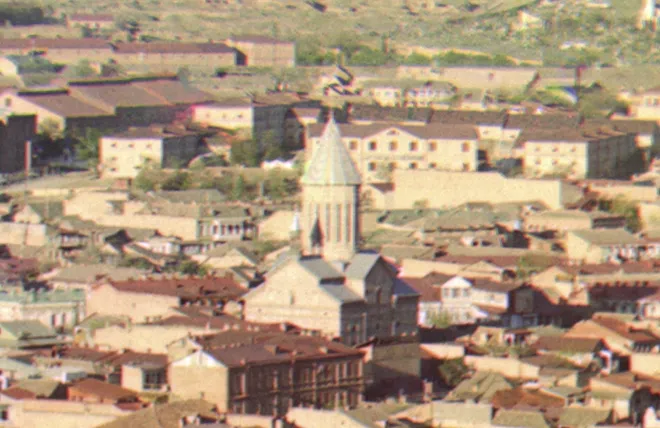
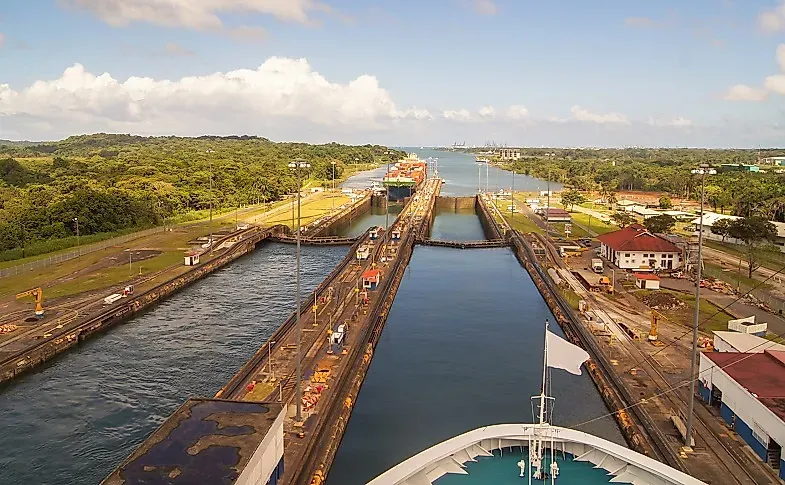 Photo: Panama Canal, via www.worldatlas.com
He had no formal vocabulary for what he was doing. He didn't know Cézanne from a cargo net. What he had was an eye trained by necessity: on ships, you look carefully or you get hurt. You read the weather, the water, the faces of men under stress. You learn to distinguish between the kind of tired that sleeps and the kind that doesn't. That education — raw, physical, experiential — would later give his murals a quality that trained artists sometimes spent entire careers trying to achieve: the sense that the figures in them had weight, history, and a life that extended beyond the frame.
He came ashore for good in 1941, twenty-four years old, with a seabag, thirty-one sketchbooks, and approximately forty dollars.
The Accident of the New Deal
He might have disappeared entirely — another drifter with a talent nobody saw — if not for a WPA program administrator in Pittsburgh named Ruth Calloway, who in 1942 was desperately trying to fill a mural commission for a new post office in Altoona, Pennsylvania. Three artists had dropped out. The deadline was six weeks away.
Vance had been sleeping on a friend's floor and doing odd jobs when Calloway's assistant, who had seen his sketchbooks at a boarding house, brought him in for a meeting. He had never painted a mural. He had barely painted anything. He showed Calloway his drawings of port workers, storm decks, and engine rooms.
She hired him on the spot.
What he produced in Altoona over the following five weeks stunned everyone who saw it. The mural — sixty feet of Pennsylvania labor history, rendered in a palette of deep ochre, coal black, and unexpected Mediterranean blue — looked like nothing else in the WPA tradition. It had the density of lived experience. The figures didn't pose; they worked. The light didn't flatter; it illuminated. A local newspaper called it "the most honest wall in Pennsylvania."
The commissions followed. Over the next twenty years, Vance painted murals in post offices, courthouses, schools, and union halls across the country, from Harrisburg to Tucson to the Pacific Northwest. Each one carried the same quality: the sense that the artist had not imagined these people but remembered them.
What the Sea Gave Him
Late in his life, Vance was asked by an interviewer whether he regretted not having formal training. He found the question genuinely puzzling.
"What would they have taught me?" he said. "How to see? I learned that on a ship in the North Atlantic in January. Nobody in a classroom is going to teach you how to look at a man's face when he's scared and working at the same time. You have to be there."
The question of what constitutes an education is one that American culture returns to repeatedly, usually without resolution. Vance's answer was implicit in every mural he painted: you learn what you live, and if you live expansively enough, the learning never stops.
He ran away from a coal town at fourteen because the world outside felt bigger than the world inside. He was right about that. And he spent the rest of his life painting it onto walls so that other people — people who might never leave their own Claysburg — could see what he had seen.
That, in the end, is what public art is for. Not decoration. Not commemoration. Transmission. A kid who lied about his age on a Baltimore dock in 1931 spent the next half century transmitting what the world looked like to someone paying close attention.
The walls are still there. The attention is still visible.