Queen Bess: The Sharecropper's Daughter Who Earned Her Wings in Paris
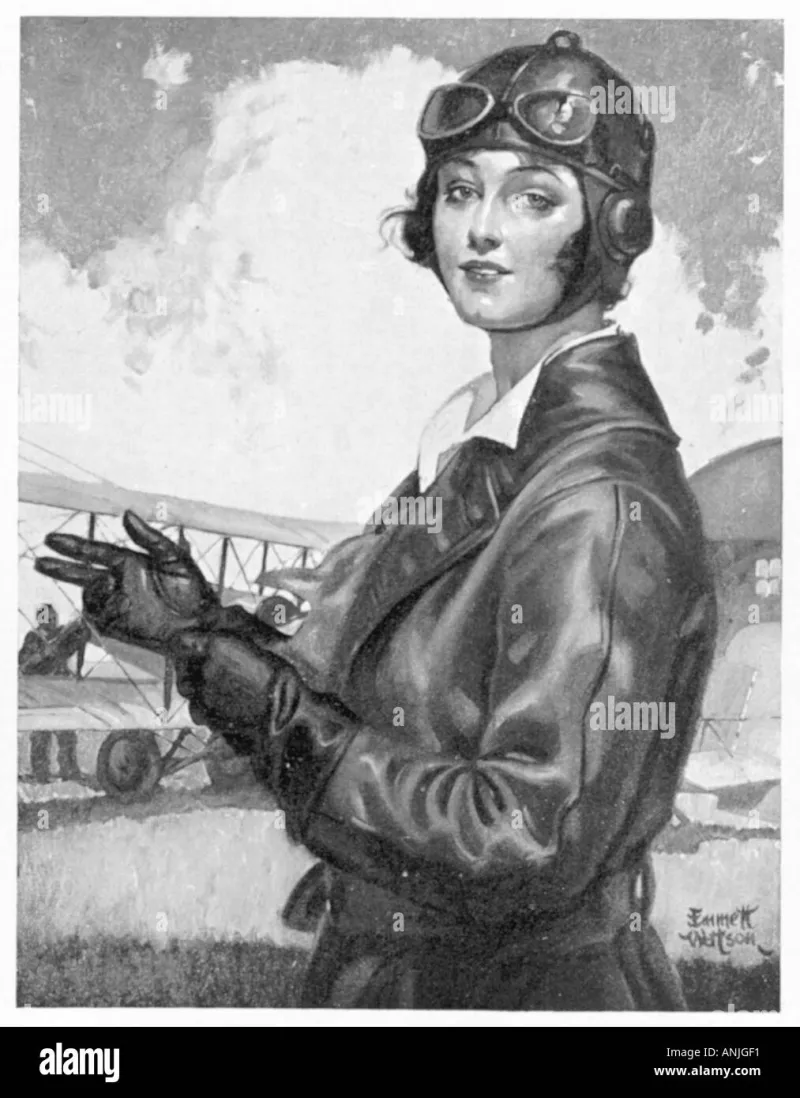
Photo: 1920s female aviator leather cap goggles vintage biplane, via c8.alamy.com
On a September afternoon in 1922, the crowds at Curtiss Field on Long Island came to see something the newspapers had promised would be a spectacle: a woman flying. Not just flying — loop-the-loops, figure eights, stunts that made hardened aviators grip the fence. The posters billed her as “Queen Bess.” Most of the audience knew the headlines. Almost none of them knew the road behind them: a cotton field in Texas, a night-school French class in Chicago, and a country that had told her no in every accent it had.
A Childhood Measured in Cotton
Bessie Coleman was born in Atlanta, Texas, in 1892, one of thirteen children in a sharecropping family. Her father was of Black and Cherokee heritage; the work was cotton, the hours ran from dawn to dark, and the school was a one-room building that opened onto fields where her classmates picked alongside her. Books came secondhand, if they came at all. By her early twenties she had saved what she could from washing other people's laundry and pointed herself north. Chicago in 1915 was loud, fast, and full of possibility, and Coleman took it as a manicurist in a South Side barbershop — and as a student of every rumor that passed through the chair. Her brother John, home from the war, mentioned that Frenchwomen were flying airplanes. He meant it as a tease. She heard it as an itinerary.
Every Door in America Slammed Shut
Coleman applied to flight schools across the United States. The answers were quick and unanimous: no. No to her race, no to her sex, sometimes no to both in the same breath. It was Robert Abbott, publisher of the Chicago Defender, who reframed the problem. If America wouldn't teach her, France would — French aviators were less interested in her skin than in her nerve. So Coleman enrolled in a Berlitz night course and taught herself French, saving her manicurist wages with help from backers who believed in the dream. In late 1920 she sailed for Europe. At the Caudron brothers' aviation school at Le Crotoy, she trained through cold, engine trouble, and the occasional instructor's condescension, and on June 15, 1921, the Fédération Aéronautique Internationale issued her a pilot's license — the first ever earned by a Black woman anywhere in the world. She was twenty-nine years old. The training had taken seven months. Getting to the boat had taken twenty-nine years.
Queen Bess Takes the Air
A license, Coleman quickly realized, was a piece of paper; spectacle was a living. She sailed back to Europe for advanced training in aerobatics, studying under pilots in France, Germany, and the Netherlands. Then she came home and made the sky her stage. Her American debut at Curtiss Field kicked off a barnstorming career that carried her across the country: loop-the-loops, figure eights, low passes that parted crowds like a comb. Audiences called her “Queen Bess” and “Brave Bessie,” and she earned both. Off the field, she drew a line that was quietly radical: she refused to perform at venues that segregated the gates. If Black spectators couldn't come in the front way, Queen Bess wouldn't fly. In 1923 she crashed in Los Angeles, breaking her leg and her ribs, and was back in the air within a year, flying war-surplus planes she bought and patched herself. “The air is the only place free from prejudices,” she said. She intended to keep it that way.
The School She Never Got to Open
Coleman's great ambition wasn't fame. It was a flight school for Black aviators — a place where no one else would have to sail to France to be taken seriously. She lectured in churches and theaters in her tailored flying uniform, raising money one speech at a time. On April 30, 1926, in Jacksonville, Florida, she was a passenger in her Curtiss Jenny during a rehearsal for a May Day show, scouting the ground for a parachute jump and, as usual, unbelted. The plane suddenly pitched into a dive. Coleman fell to her death at thirty-four; her mechanic died in the wreck. The school she dreamed of never opened under her name.
Still Climbing
But it opened anyway, in a hundred ways. Within three years, enthusiasts in Los Angeles founded the Bessie Coleman Aero Club to train Black pilots and mechanics whom other schools shut out. Flying clubs and scholarships now carry her name, the Postal Service put her on a stamp in 1995, and a road by Chicago's O'Hare airport points travelers past a reminder of who belongs in the sky. Each year, pilots honor her with a flyover, dropping flowers on the grave of a woman who never stopped climbing to get there. Bessie Coleman's beginning was as improbable as they come — a sharecropper's daughter with a borrowed language and a one-way ticket. What she made of it is the reason the sky looks different.