Nothing to Her Name, Everything in Her Hands: How One Immigrant Seamstress Built a Fashion Empire
The first thing Yeva Marchenko ever sewed was a winter coat for her younger brother. She was nine years old, living in a small apartment in Kharkiv, Ukraine, and the coat her brother needed cost more than her family could spend. So her mother handed her a needle, a spool of dark thread, and a bolt of wool fabric salvaged from a neighbor's discard pile, and said, more or less: figure it out.
She did. The coat was imperfect — one sleeve slightly longer than the other, the lining bunched at the collar — but it was warm, and it was made, and that distinction mattered enormously to a nine-year-old who had just learned something fundamental about herself.
Thirty years later, that same woman would be sitting in the front row at New York Fashion Week, watching models walk a runway in her designs, wearing clothes that had been written about in Vogue, WWD, and the New York Times Style section. The path between those two moments was not a straight line. It was barely a path at all.
A Crossing Built on Borrowed Courage
Yeva arrived in New York City in 1999, at twenty-six, through a combination of a refugee resettlement program and the stubborn generosity of a distant cousin in Brooklyn who offered her a couch and a phone number for a garment district employment agency. Her English consisted of roughly forty words, most of them learned from an American pop music cassette she'd played until it warped.
She was placed almost immediately as a sample-room assistant in a mid-market sportswear company in the Garment District — a job that involved, in those early weeks, mostly fetching fabric bolts and pressing seams under the supervision of women who communicated with her primarily through hand gestures and expressions of mild exasperation.
But Yeva watched everything. She watched how the senior patternmakers graded sizes. She watched how the sample sewers interpreted designer sketches. She watched the designers themselves — mostly young, mostly American, mostly educated at schools whose names she couldn't yet pronounce — and she noticed something that surprised her: for all their training, many of them struggled with the translation between idea and cloth. They could draw. They could mood-board. But the physical logic of fabric — how it moved, how it gave, how it failed — sometimes eluded them.
For Yeva, that logic was the only language she'd ever been fluent in.
The Education Nobody Gave Her
Over the next six years, she cycled through four different companies in the Garment District, each one slightly more prestigious than the last. She sewed samples. She corrected patterns. She occasionally, quietly, fixed mistakes that nobody wanted to acknowledge had been made. Her English improved in the way that things improve when survival depends on them — fast, functional, and flavored by the specific vocabulary of the industry she was absorbing.
She was also, in every spare hour, designing.
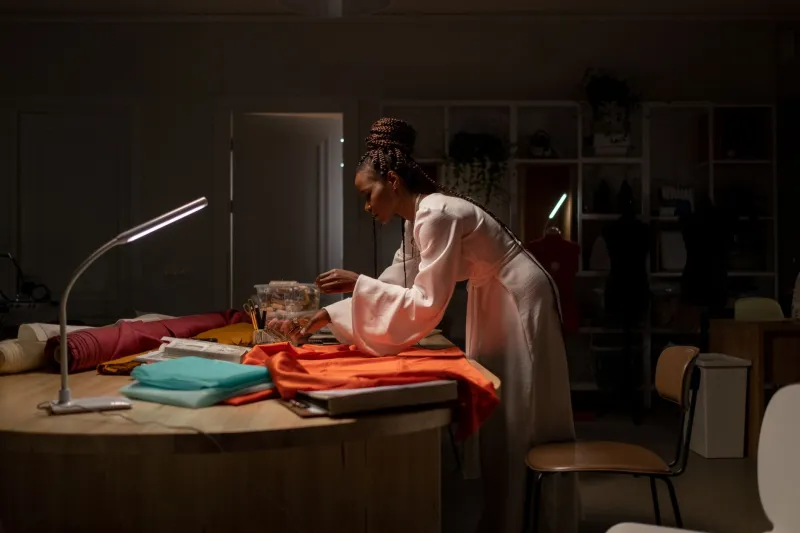
Not on paper, the way she'd watched designers do it. Yeva worked directly in fabric — draping muslin over a dress form in her apartment, pinning and cutting and adjusting until the shape in her mind existed in three dimensions in front of her. It was the method she'd always used, because it was the only method she'd had access to. She'd never owned a sketchbook. She'd learned to think in cloth.
What emerged from this process was a design sensibility that didn't look like anything else on the market. Her pieces were structured but unconventional — asymmetrical in ways that felt intentional rather than artsy, built with the kind of internal engineering that came from someone who understood garment construction at a molecular level. The cultural references were layered and strange in the best way: Eastern European folk textile traditions filtered through the visual noise of New York City, rendered in materials that were often unexpected — industrial fabrics, repurposed textiles, the occasional element that had no business being in a fashion garment until it suddenly, obviously, did.
The Break That Almost Wasn't
In 2005, Yeva spent four months making a ten-piece collection in her apartment. She couldn't afford a proper showroom. She couldn't afford PR. What she could afford was a table at a Brooklyn flea market, where she sold three pieces in two weekends and got a business card from a woman who turned out to be a stylist for a mid-level celebrity whose name Yeva didn't recognize.
The stylist put one of Yeva's jackets on her client for a magazine shoot. The magazine was not Vogue. It was a regional fashion publication with a circulation of roughly 40,000. But one of those 40,000 readers was a buyer for a boutique in Manhattan's West Village who called the number on the business card — Yeva's cell phone — and asked if she could come see more work.
Yeva brought everything she had in two garment bags on the subway. The buyer ordered twelve pieces. Then twenty. Then called a friend at a larger boutique in Los Angeles.
By 2008, Yeva Marchenko had a real company. By 2012, she had a flagship store in Soho and a wholesale presence in thirty-seven boutiques across the country. By 2016, she was showing at New York Fashion Week — not as a scrappy emerging designer curiosity, but as a label with a genuine following and a waiting list for her signature structured coats.
What the Outsider Sees
When journalists ask Yeva about her design philosophy — and they ask often now — she tends to answer in a way that surprises people. She doesn't talk about inspiration in the abstract. She talks about constraint.
"When you grow up without options, you learn to see what's actually there," she said in a 2019 interview. "I never had the luxury of throwing something away and starting over. Every piece of fabric had to become something. That's still how I work."
It shows. Her collections are notably low-waste by industry standards. Her construction techniques — many of them developed in that Brooklyn apartment with a secondhand machine and a lot of ingenuity — are studied now by design students at schools whose names she has long since learned to pronounce.
The coat she made for her brother at nine years old is gone, lost somewhere across three decades and an ocean. But the woman who made it is still, at her core, the same person: someone who looks at a length of fabric and sees not what it is, but everything it could be.