The Dishwasher Diplomat: How a Hungarian Refugee's Broken English Won the Cold War
Forty Dollars and a Dream
Andrew Toma stepped off the ship in New York Harbor on a gray November morning in 1956, carrying everything he owned in a battered suitcase. The Hungarian Revolution had failed, Soviet tanks had rolled through Budapest, and like thousands of his countrymen, Toma had chosen exile over submission.
 Photo: New York Harbor, via pisces.bbystatic.com
He spoke perhaps fifty words of English, had no family in America, and possessed no skills that seemed valuable in his new country. What he did have was something rarer than any credential: an almost supernatural ability to understand what people meant when words failed them.
This gift, honed in the multilingual chaos of post-war Eastern Europe, would eventually make him one of the most important figures in American diplomacy—though his name would never appear in headlines.
Washing Dishes, Learning America
Toma's first job was in the kitchen of a Manhattan diner, where he scrubbed pots for twelve hours a day and studied English from a dictionary he kept propped against the dishwasher. The other workers spoke a babel of languages—Spanish, Italian, Polish, Yiddish—and Toma discovered he could navigate these conversations not through vocabulary but through tone, gesture, and the spaces between words.
He enrolled in night school at a community college, where his professors noticed something unusual. While other foreign students struggled with grammar and pronunciation, Toma seemed to grasp the emotional undertones of English with startling accuracy. He could sense when someone was lying, when they were afraid, when they meant the opposite of what they said.
The Breakthrough Moment
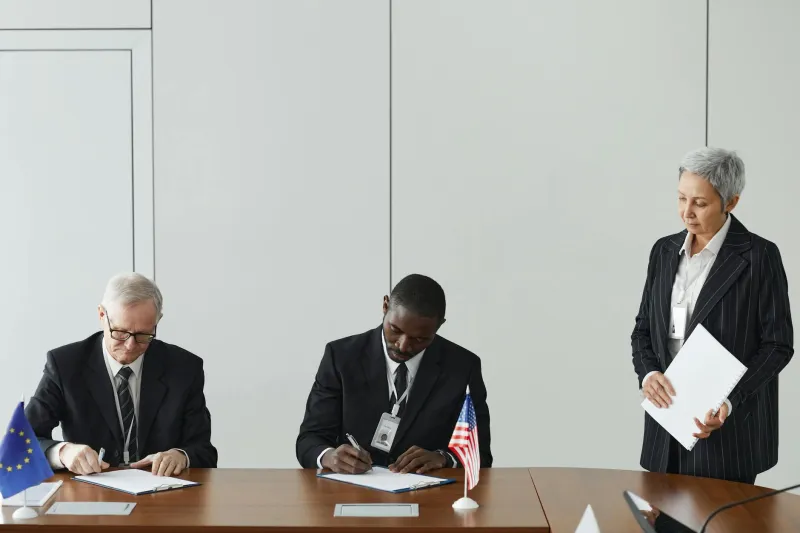
In 1962, a chance encounter changed everything. Toma was working as a part-time translator at the United Nations when a heated exchange erupted between Soviet and American delegates during a routine trade negotiation. The official interpreters were faithfully translating words, but the real communication—the threats, the concessions, the desperate attempts at face-saving—was happening in subtext.
 Photo: United Nations, via bunjji.com
Toma stepped in, not just translating language but interpreting intention. He caught the Soviet delegate's subtle signal that he was willing to compromise, and the American's carefully disguised eagerness for a deal. Within hours, a negotiation that had stalled for weeks was moving toward resolution.
Word of the Hungarian dishwasher who could read minds spread through diplomatic circles.
The Cold War Whisperer
By 1965, Toma had become the State Department's secret weapon. While his official title was "Senior Linguistic Consultant," his real job was decoding the human drama behind international crises.
During the Cuban Missile Crisis aftermath, Toma sat in rooms where the fate of civilization hung on nuanced communication between superpowers. He translated not just Russian and English, but fear and bravado, desperation and determination. His ability to sense when Khrushchev's representatives were bluffing—and when they weren't—may have prevented nuclear war.
Toma developed techniques that seemed more like psychology than linguistics. He studied facial expressions, breathing patterns, the way people held their hands when they lied. He learned to recognize the difference between a negotiating position and a genuine red line.
The Art of Understanding
What made Toma extraordinary wasn't his language skills—though he eventually mastered eight languages—but his insight into human nature. Growing up in the ethnic mosaic of pre-war Hungary, surviving the Nazi occupation, and witnessing the Soviet takeover had taught him that survival often depended on understanding what people really meant, not what they claimed to believe.
He could sense when a hardline Soviet negotiator was actually looking for a way to compromise without losing face. He understood when American officials were genuinely committed to a position or just posturing for domestic political reasons. This emotional intelligence made him invaluable in an era when misunderstanding could trigger global catastrophe.
Behind the Scenes of History
Toma's fingerprints are on some of the Cold War's most important diplomatic breakthroughs, though his role remained classified for decades. He facilitated arms control negotiations, helped resolve the Berlin Crisis, and played a crucial part in establishing the cultural exchange programs that began to thaw relations between East and West.
His greatest triumph came during the SALT I negotiations, where his ability to navigate the emotional landscape of nuclear disarmament talks helped both sides find language that allowed them to step back from the brink while maintaining their dignity.
The Invisible Peacemaker
Andrew Toma retired in 1985, just as the Cold War was beginning its final act. He had spent nearly three decades in windowless rooms, translating not just words but the hopes and fears of world leaders. He never gave interviews, never wrote memoirs, never sought credit for his role in keeping the peace.
He returned to his small apartment in Queens, where neighbors knew him only as the quiet Hungarian man who helped their children with homework and grew tomatoes in his backyard garden.
The Refugee's Gift to America
Toma's story reminds us that America's greatest strength has always been its ability to transform outsiders into insiders, to take the skills that refugees and immigrants bring and channel them toward the national good. The dishwasher who became a diplomat proved that understanding transcends language, and that sometimes the most important conversations happen in the spaces between words.
In an age when translation apps can handle basic communication, Toma's legacy lies in his reminder that true understanding requires not just linguistic skill but human empathy—the ability to hear what someone is really saying when they can't quite say it themselves.
The Hungarian refugee who helped win the Cold War with broken English showed that America's secret weapon isn't our technology or our military might—it's our capacity to see the humanity in our enemies and find common ground even in the most impossible circumstances.