Rhythm Without Rules: The Mississippi Boy Who Couldn't Hear Half the Beat but Changed All of Music
The Dare That Changed Everything
Johnny Lee Washington never planned to touch a drum kit. Growing up in Clarksdale, Mississippi, in 1962, he was the quiet kid who sat in the back of his high school band class, partially deaf in his left ear from a childhood infection that doctors couldn't afford to treat properly. Music felt like watching a movie with half the dialogue missing—he caught pieces, but never the whole conversation.
 Photo: Clarksdale, Mississippi, via res.cloudinary.com
Then Tommy Morrison dared him to play.
Tommy was the school's star drummer, the kid who could nail every Buddy Rich solo and made the high school jazz ensemble sound like they belonged in Memphis clubs. During lunch break, he pointed at Johnny and announced to their friends: "Bet you Johnny can't even keep a basic 4/4 beat." The laughter that followed wasn't mean-spirited, just the casual cruelty of teenagers who'd found an easy target.
Johnny walked over to Tommy's kit and picked up the sticks.
Learning to Feel What You Can't Hear
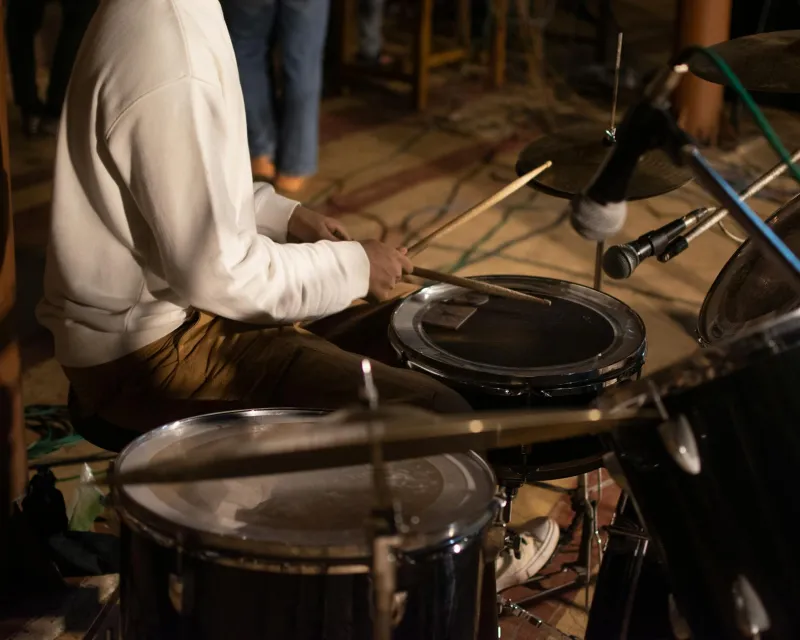
What happened next confused everyone, including Johnny. Unable to hear the high frequencies that most drummers rely on—the crack of the snare, the sizzle of cymbals—Johnny had to feel his way through rhythm. He pressed his feet against the floor to catch vibrations, watched the way other musicians' bodies moved to anticipate tempo changes, and developed an internal sense of timing that had nothing to do with traditional musical cues.
His technique looked wrong to anyone who'd learned drums the conventional way. Johnny held his sticks at unusual angles to maximize the physical feedback he could feel through his hands. He played ghost notes—barely audible hits—not for musical effect, but because the subtle vibrations helped him track where he was in complex rhythms. His bass drum patterns followed an internal logic that professional drummers couldn't decode.
But somehow, it worked. More than worked—it grooved in ways that made other musicians stop what they were doing and listen.
The Sound That Shouldn't Exist
By his senior year, Johnny was playing weekend gigs at juke joints along Highway 61, backing blues musicians who'd never heard anything like his approach to rhythm. His partial deafness meant he emphasized different elements of the beat—the deep, felt vibrations of bass drums and floor toms rather than the sharp attacks that most drummers featured. The result was a pocket that felt both loose and tight, like music that was breathing.
Local musicians started requesting Johnny specifically, not because they understood his technique, but because something about his playing made their own performances feel more alive. Guitar players found themselves exploring rhythmic patterns they'd never attempted. Bass players discovered pockets within pockets that they hadn't known existed.
But when Johnny auditioned for music programs at colleges across the South, every instructor told him the same thing: his technique was fundamentally flawed. He'd need to unlearn everything and start over with proper form.
Johnny decided to skip college entirely.
The Studio Where Rules Didn't Matter
In 1983, Johnny caught a ride to Nashville with a blues guitarist who'd been impressed by his playing at a Clarksdale club. The guitarist had a session at a small studio where the owner, a former jazz musician named Carl Phillips, was known for taking chances on unconventional players.
Carl listened to Johnny play for exactly ninety seconds before offering him regular session work.
"I don't know what you're doing," Carl told him, "but it's making everyone else sound better."
Over the next five years, Johnny became Nashville's most requested session drummer for artists who wanted something different. His approach to rhythm—developed out of necessity in a Mississippi high school—began influencing country, blues, and rock recordings. Musicians who'd initially been skeptical found themselves asking Johnny to explain techniques they couldn't replicate.
The problem was, Johnny couldn't explain them. His playing came from adaptation, not theory. He'd developed a musical language that worked around his limitations, creating something entirely new in the process.
When Different Becomes Revolutionary
By 1990, younger drummers were traveling to Nashville specifically to study with Johnny, trying to reverse-engineer a style that had emerged from physical necessity rather than musical choice. Drum magazines featured articles analyzing his "ghost note philosophy" and "vibrational timing concepts"—academic language for techniques that Johnny had developed simply because he couldn't hear what other drummers took for granted.
The irony wasn't lost on Johnny. The same playing style that had been dismissed as fundamentally flawed in college auditions was now being taught as advanced technique in music schools across the country. Drummers who could hear perfectly were trying to recreate the adaptations that Johnny had made because he couldn't.
The Teacher Who Never Meant to Teach
Johnny eventually opened a small teaching studio outside Nashville, not because he wanted to formalize his approach, but because so many musicians kept asking for lessons. His method remained unconventional—instead of teaching standard rudiments, he had students play with earplugs to develop internal timing, or practice on silent drum pads to focus on physical feedback rather than audible results.
"Most people think rhythm is something you hear," Johnny would tell his students. "But rhythm is something you feel. Once you understand that, you can play music that other people can feel too."
Today, Johnny's influence runs through multiple generations of drummers who've incorporated his techniques into their own playing. His approach—born from a childhood infection in rural Mississippi—has become part of the standard vocabulary of American rhythm. Music schools now teach "vibrational drumming" as a legitimate technique, never quite acknowledging that it began as one teenager's adaptation to hearing loss.
The Beat That Built Itself
Johnny Washington never set out to revolutionize drumming. He just wanted to play music, and his partial deafness forced him to find a different way to connect with rhythm. In trying to work around what he couldn't hear, he discovered musical possibilities that fully hearing drummers had missed entirely.
His story suggests something profound about the nature of innovation: sometimes the most revolutionary ideas come not from perfecting what already exists, but from finding new ways to approach problems that everyone else assumes have already been solved. Johnny couldn't hear half the beat, so he created a whole new way to feel it—and in doing so, changed how everyone else understood rhythm itself.