Second Acts, First Victories: When American Athletes Proved Age Is Just a Number
The Beautiful Impossibility of Late Blooming
In American sports, we worship youth like a religion. Draft prospects are dissected at nineteen, careers are considered over at thirty, and the phrase "past their prime" gets thrown around like a medical diagnosis. But every so often, an athlete refuses to accept the expiration date society has stamped on their dreams—and delivers a performance that makes everyone remember why we fell in love with sports in the first place.
These are their stories: athletes who found their greatest moments not at the beginning of their careers, but when everyone expected them to end.
The Quarterback Who Came Back From the Dead
Doug Flutie: From CFL Exile to NFL Magic
In 1998, Doug Flutie was 36 years old and hadn't thrown a meaningful NFL pass in eight years. The former Heisman Trophy winner had been exiled to the Canadian Football League, written off as too small for the American game. NFL executives had convinced themselves that his college heroics were flukes, that his 5'10" frame couldn't survive against bigger, faster professional defenses.
 Photo: Doug Flutie, via img.playerswiki.com
Then the Buffalo Bills, desperate and out of options, gave him one last chance.
What happened next was pure magic. Flutie didn't just play—he dominated. His scrambling ability, honed by years of proving doubters wrong, turned broken plays into touchdowns. His arm strength, supposedly diminished by age, delivered passes that younger quarterbacks couldn't make. In his first season back, he led Buffalo to the playoffs for the first time in years.
"Everyone said I was too old, too small, too Canadian," Flutie recalled. "But they forgot that I'd been preparing for this comeback my entire career. Every time someone told me I couldn't do something, I got a little bit stronger."
Flutie's late-career renaissance lasted four seasons and included some of the most memorable moments in Bills history. He proved that sometimes the best way to handle being written off is to write your own ending.
The Fighter Who Refused to Stay Down
George Foreman: From Grill Salesman to Heavyweight Champion
By 1987, George Foreman was selling grills on late-night television and preaching at a small church in Texas. His boxing career had been over for a decade, ended by Muhammad Ali's rope-a-dope strategy in Zaire. At 38, he was twenty pounds overweight and seemingly content with retirement.
 Photo: George Foreman, via image.tmdb.org
Then he stepped back into the ring and reminded everyone why they used to call him "Big George."
Foreman's comeback wasn't pretty—he moved like a man carrying invisible furniture, his punches came in slow motion, and younger fighters danced circles around him. But what he lacked in speed, he made up for in devastating power and an almost supernatural ability to absorb punishment.
For seven years, he methodically worked his way back up the heavyweight rankings, knocking out fighters half his age with punches that seemed to come from another era. Then, in 1994, at age 45, he faced Michael Moorer for the heavyweight championship.
Moorer was younger, faster, and winning every round. Then, in the tenth round, Foreman landed a right hand that sent the champion crashing to the canvas. At 45 years and 299 days old, George Foreman became the oldest heavyweight champion in boxing history.
"They said I was too old to fight," Foreman said after the victory. "But age is just a number. Heart is what matters, and my heart never got old."
The Sprinter Who Ran Into History
Gail Devers: From Hospital Bed to Olympic Gold
In 1990, Gail Devers couldn't walk to her mailbox without collapsing from exhaustion. The former UCLA sprinter was suffering from Graves' disease, an autoimmune disorder that had destroyed her thyroid and left her so weak she could barely stand. Doctors told her that her running career was over, that she should focus on getting healthy enough to live a normal life.
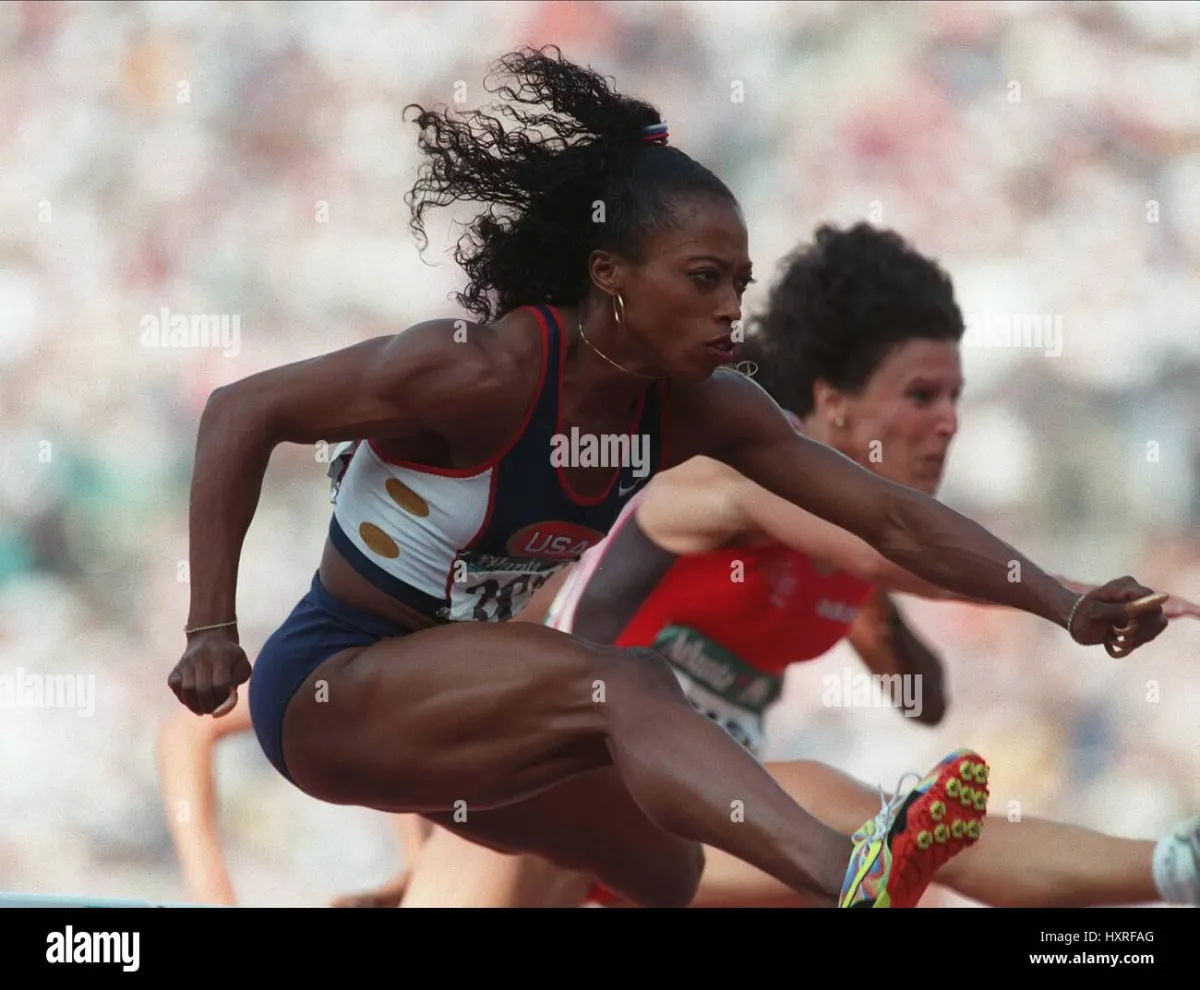 Photo: Gail Devers, via c8.alamy.com
Devers had other plans.
After two years of experimental treatments that nearly resulted in foot amputation, she slowly began training again. Her times were embarrassing—she couldn't break 13 seconds in the 100-meter hurdles, a race she'd once dominated. But every day, she got a little bit faster, a little bit stronger.
By 1992, she had qualified for the U.S. Olympic team in both the 100 meters and 100-meter hurdles. At the Barcelona Olympics, she won gold in the 100 meters, running 10.82 seconds—faster than she'd ever run before her illness.
"When you've been that close to losing everything, winning becomes a different kind of beautiful," Devers explained. "Every step I took in that race was a step away from the hospital bed where I thought my dreams had died."
She would go on to win another Olympic gold medal in 1996, proving that sometimes the greatest victories come not from natural talent, but from refusing to accept defeat.
The Hockey Player Who Wouldn't Retire
Gordie Howe: The Grandfather on Ice
Gordie Howe retired from the Detroit Red Wings in 1971 at age 43, his body battered by 25 seasons of professional hockey. He was inducted into the Hockey Hall of Fame immediately, his legendary career seemingly complete.
Two years later, he came out of retirement to play alongside his sons in the World Hockey Association. He was 45 years old, playing against athletes young enough to be his grandchildren.
For six seasons, Howe dominated a league filled with players in their twenties. His elbows were still sharp, his shot still deadly, and his hockey sense still supernatural. In 1974, at age 46, he scored 100 points—a milestone that most players never reach at any age.
When the WHA folded in 1979, Howe returned to the NHL for one final season with the Hartford Whalers. At age 51, he was still playing professional hockey, still scoring goals, still proving that experience and determination could overcome the limitations of time.
"People kept asking when I was going to act my age," Howe said. "I told them I was acting my age—I was acting like someone who loved hockey too much to quit."
The Lesson in Every Late Bloom
These athletes shared something beyond talent or determination: they understood that greatness doesn't follow a schedule. While their younger competitors were worried about peak performance windows and biological clocks, these late bloomers were focused on something simpler—the pure joy of proving that impossible is just another word for challenging.
In a culture obsessed with youth and early achievement, they remind us that some stories get better with age, that experience can be more valuable than athleticism, and that the most satisfying victories often come when everyone expects you to lose.
They proved that in sports, as in life, it's never too late to write a new chapter—especially if you're stubborn enough to ignore everyone who says the book should already be closed.