He Couldn't Decode a Single Page — So He Built a System That Preserved Thousands
The first time Elias Croft held a piece of genuine American history in his hands, he couldn't read a word of it.
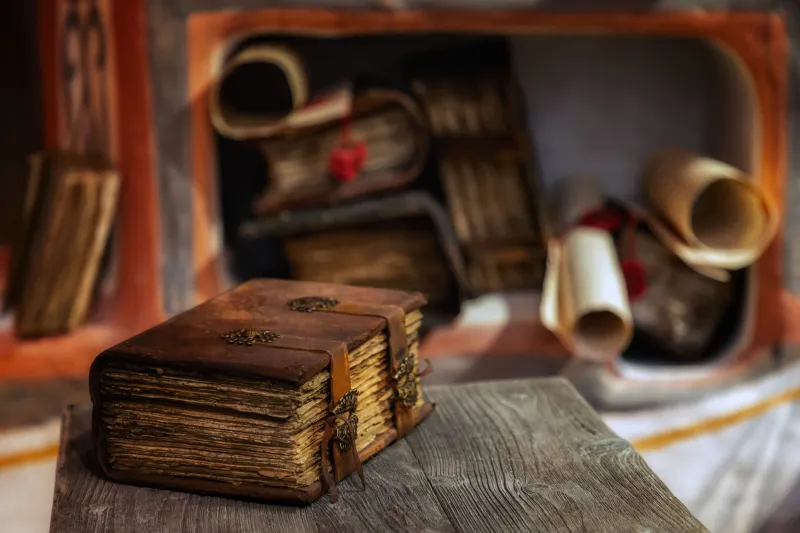
It was 1948. He was twenty-three years old, working as a day laborer on a demolition crew in rural western Pennsylvania, helping to clear the contents of an old farmhouse scheduled to come down. In a trunk in the attic, under a quilt and a broken clock, he found a bundle of letters tied with a leather cord. The handwriting was looping and old-fashioned. The paper was thin as a whisper.
Croft couldn't make out what the letters said. He'd never been able to make out much of anything written down. The words moved on him, rearranged themselves, broke apart in ways that made other people's effortless reading seem like a magic trick he'd never been taught.
But he knew, with a certainty he couldn't explain, that these letters mattered. He could feel the weight of them — not physically, but in some other way. He carried them off the demolition site in his jacket pocket, which was either theft or salvation, depending on how you look at it.
What he built from that moment, over the next four decades, would eventually be recognized as one of the most significant privately assembled historical archives in the northeastern United States.
A Mind That Worked Differently
Elias Croft grew up in Allegheny County, the youngest of five children, in a household where nobody had the time or vocabulary to recognize what we now call dyslexia. He was labeled slow. He was held back twice. He left school at fifteen with the general understanding, shared by teachers and himself alike, that books were not his domain.
What nobody noticed — or nobody thought to mention — was that Croft had an almost supernatural spatial memory. He could walk through a building once and reproduce its floor plan from memory weeks later. He could look at a photograph and describe, years afterward, exactly where every object in it had been positioned. He remembered faces, textures, the color of ink on aged paper, the particular smell of a document that had been stored in a cedar chest versus a metal box.
He just couldn't decode the words on the page.
"He experienced documents as objects," said Dr. Patricia Lund, an archivist and historian who worked with Croft in the 1970s and later wrote about his methods. "Most of us are trained to see a document as a vessel for its text. Elias saw it as an artifact. Everything about it mattered — the paper, the binding, the condition, the context of where it was found. In some ways, that's a more complete form of archival thinking than anything I was taught in graduate school."
The System Born from Necessity
By the mid-1950s, Croft had accumulated enough rescued documents — pulled from estate sales, demolition sites, barn cleanouts, and the occasional dumpster — that he needed a way to organize them. He couldn't catalog them by reading their contents. So he invented something else.
He developed a physical classification system based on material characteristics: paper weight and color, ink type, binding method, geographic origin (determined by the location of discovery and by asking someone he trusted to read him the place names), approximate date range estimated by material composition, and condition grade. He built wooden filing structures — he was handy with tools — and coded each document's location using a combination of colored tags and hand-drawn symbols that he could read fluently because he'd invented them himself.
It sounds improvised because it was. It was also, as historians would later recognize, remarkably sophisticated.
"What Elias created was essentially a provenance-first cataloguing system," said Dr. Lund. "Most archives of that era were organized primarily by content — who wrote what, when. His system prioritized physical context and origin. Where did this come from? What was it near? What does its physical condition tell us about how it was kept? Those questions are now considered essential in archival science. He was asking them in 1955 because he had no other choice."
Building Something Nobody Planned
Croft never set out to build a library. He set out to keep things from disappearing.
Throughout the 1960s and into the 1970s, he worked construction during the day and spent evenings and weekends expanding his collection and refining his organizational methods. He hired a series of part-time assistants — mostly young people, often students — who could read the documents aloud to him while he listened, categorized, and directed their placement with an exactitude that consistently surprised them.
He was not a passive listener. He asked precise questions. He remembered everything he was told. He built cross-referencing systems that allowed him to connect documents across collections in ways that even his assistants, who could read every word, hadn't noticed.
By 1971, the collection occupied the entire ground floor of his house in Greensburg, Pennsylvania, and had begun to attract serious attention from academic historians. A professor from the University of Pittsburgh who visited that year later described it as "the most unexpectedly rigorous private archive I have ever encountered."
In 1979, with assistance from a local historical foundation, Croft incorporated his collection as the Westmoreland Document Preservation Society. It was eventually housed in a dedicated facility and is now maintained by a professional staff. The cataloguing system Croft invented — refined over decades, but still recognizably his — remains in use.
What Limitation Taught the Field
Croft lived until 2001. In his later years, he gave occasional talks to archival and library science students, usually at the insistence of Dr. Lund or other colleagues who understood his significance. He was not a comfortable public speaker. He was honest about his dyslexia in ways that, even in the 1990s, took some courage.
What he told students, consistently, was this: he had never seen his inability to read as the central fact of his work. It was a constraint, and constraints force creativity. Every system he'd built, he'd built because the standard approach wasn't available to him. And in building around the standard approach, he'd sometimes found something better.
"The people who designed the old systems never had to question them," he said in a 1994 talk recorded by a library science student. "I had to question everything. That turns out to be useful."
He couldn't read the letters he found in that Pennsylvania attic in 1948. But he spent the rest of his life making sure letters like them — thousands of them, from ordinary Americans whose stories might otherwise have crumbled to dust — would survive long enough for someone else to read them.
That's not a workaround. That's a vocation.