They Were Trying to Fix One Thing. They Changed Everything.
Photo: Oliksiy Yakovlyev, CC0, via Wikimedia Commons
When the Wrong Answer Is Worth a Fortune
There's a version of the inventor story we all know: the lone genius, the eureka moment, the world transformed. It's a clean narrative, and it's almost never true.
The messier, more honest version looks like this: someone is trying to solve a small, specific, genuinely annoying problem. They fail at that. But in the process of failing, they stumble into something so unexpectedly useful that it eventually reaches millions of people who have no idea where it came from or what the original question even was.
America has produced these accidental architects in remarkable numbers. Here are five of them.
1. The Veterinarian and the Feed That Fed the Nation
In the 1890s, Dr. John Harvey Kellogg wasn't thinking about breakfast. He was thinking about digestion — specifically, the digestive health of the patients at his Battle Creek Sanitarium in Michigan, where he ran a health retreat built around his deeply held, occasionally eccentric beliefs about diet, exercise, and moral hygiene.
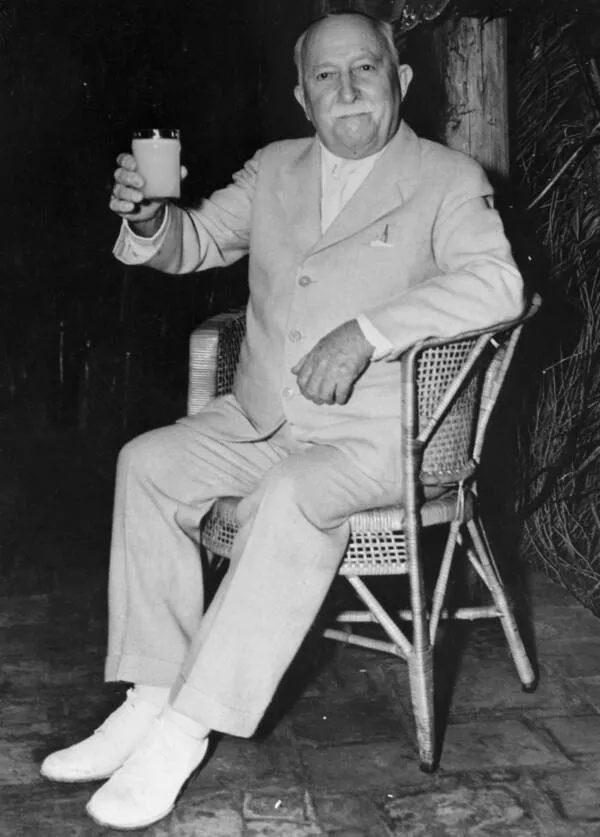 Photo: John Harvey Kellogg, via allthatsinteresting.com
 Photo: Battle Creek Sanitarium, via upload.wikimedia.org
Kellogg and his brother Will were trying to develop a soft, easily digestible wheat preparation for patients with sensitive stomachs. The experiment kept going sideways. Cooked wheat dough, when they let it sit too long before processing it, would break apart into flakes instead of rolling out smoothly. For weeks, this was a failure. An embarrassing, wasteful failure.
Then someone tasted the flakes.
Will Kellogg eventually pushed the concept toward corn, added sugar over his brother's furious objections, and started selling the product commercially. The cereal industry — a multibillion-dollar category that now fills entire supermarket aisles — traces its commercial DNA directly to a botched batch of wheat dough in a Michigan sanitarium kitchen.
John Harvey Kellogg never wanted to sell breakfast food. He wanted to fix digestion. He failed at that. The world ate something else entirely.
2. The Textile Worker Who Untangled More Than Thread
In early nineteenth-century New England textile mills, the machines that sewed fabric together were maddening contraptions. Thread broke constantly. Needles jammed. The fundamental problem was mechanical: a single thread pulled from above couldn't complete a stitch without a second thread coming from below, and nobody had figured out how to make that exchange happen reliably at speed.
Elias Howe spent years in grinding poverty trying to solve the wrong part of this problem. He kept designing systems that mimicked hand-sewing — needle going all the way through the fabric, looping underneath, coming back up. It didn't work. Couldn't work at any practical speed.
The breakthrough came when Howe stopped trying to replicate what hands did and started thinking about what a machine could do instead. Moving the eye of the needle to the tip rather than the base — a simple inversion that felt almost embarrassingly obvious in retrospect — allowed a second thread to form a lockstitch underneath the fabric without the needle needing to travel all the way through.
Howe wasn't trying to revolutionize manufacturing. He was trying to stop thread from breaking. What he accidentally built was the mechanical logic that still underlies virtually every industrial sewing machine operating today. Factories from Bangladesh to North Carolina run on a principle a frustrated New Englander stumbled onto while trying to solve a much smaller annoyance.
3. The Pharmacist Who Couldn't Stop a Headache — and Started a Global Industry
Caleb Bradham was a pharmacist in New Bern, North Carolina, in the 1890s. He was also, like many pharmacists of his era, an amateur chemist who enjoyed experimenting with flavored soda water mixtures at his shop's counter — partly as entertainment, partly as a way to attract customers.
 Photo: New Bern, via www.southernliving.com
His original goal was therapeutic: he wanted to create a digestive tonic that would also taste good. Something to settle stomachs, boost energy, and aid digestion. The formula he landed on — kola nuts, vanilla, caramel, sugar, and carbonated water — worked reasonably well as a refreshing drink but was, by any honest assessment, a failure as a medicine.
Bradham didn't have a drug. He had a soda.
He called it Brad's Drink initially, then renamed it Pepsi-Cola in 1898, leaning into the pepsin enzyme he believed gave it digestive properties. The digestive claims quietly faded. The drink did not. Pepsi-Cola became one of the most consumed beverages in human history, not because Bradham solved the problem he started with, but because the thing he made while trying to solve it turned out to be something people wanted for entirely different reasons.
4. The Engineer Whose Mistake Stuck Around
In 1968, Spencer Silver was working as a chemist at 3M, tasked with developing a strong adhesive — specifically, something that could bond aerospace components reliably under stress. What he produced was, by every measure of that assignment, a disappointment: a low-tack, repositionable adhesive that stuck to surfaces lightly and could be peeled away without leaving residue.
It was the opposite of what he'd been asked to make.
Silver spent years trying to interest colleagues in his failed adhesive, convinced it had some application even if he couldn't quite name it. He gave seminars. He wrote internal memos. Mostly, people were politely uninterested. A glue that didn't really stick wasn't obviously useful.
Then a colleague named Art Fry, frustrated by bookmarks that kept falling out of his church choir hymnal, remembered Silver's strange adhesive and applied it to small pieces of paper.
The Post-it Note entered the market in 1980. 3M now sells them in more than 100 countries. The entire product category — repositionable paper notes — exists because an engineer failed to make a strong glue and spent years refusing to throw his failure away.
5. The Rancher Who Was Just Trying to Keep Flies Off His Cattle
In rural Texas in the early twentieth century, a cattle rancher whose name has largely been lost to history was experimenting with a mixture of oils and waxes intended to repel insects from livestock. The flies were destroying his herd's productivity, and the commercial repellents of the era were either ineffective or too expensive to apply at scale.
His homemade formula worked reasonably well on cattle hides. But a neighbor noticed something else: applied to leather saddles and boots, the mixture preserved and waterproofed the material in a way that nothing commercially available could match. Word spread. A local leather goods shop started buying the mixture in small quantities.
Within a decade, variations of this basic wax-and-oil formula had become a staple of American leather care — the conceptual ancestor of the boot and saddle conditioners that line hardware store shelves today. The rancher never got rich from it. The neighbor who recognized its secondary application did somewhat better.
The flies, for what it's worth, mostly won.
The Pattern Nobody Plans For
What connects these five stories isn't genius, exactly. It's something more stubborn and less glamorous: the refusal to discard a thing just because it didn't do what you originally needed it to do.
Kellogg's flakes were a failed batch. Silver's adhesive was a missed target. Bradham's tonic was a therapeutic dud. In each case, the value wasn't in solving the original problem — it was in noticing what the failed solution was actually good for.
The most improbable empires in American history were built on exactly that kind of noticing. Not the eureka moment. The quieter, stranger moment that comes right after failure, when someone looks at the wreckage and thinks: wait, but what if this is actually something else?