
The Sound of Something Different
In the summer of 1962, a maintenance worker at the Philadelphia Orchestra was cleaning out a storage room when he discovered a box of wire recordings labeled "S. Hartwell - Symphony Drafts." The spools contained something extraordinary: fully formed orchestral compositions hummed by a man with a voice like gravel and an ear like Mozart. These recordings would eventually lead to one of the most unusual posthumous debuts in classical music history.
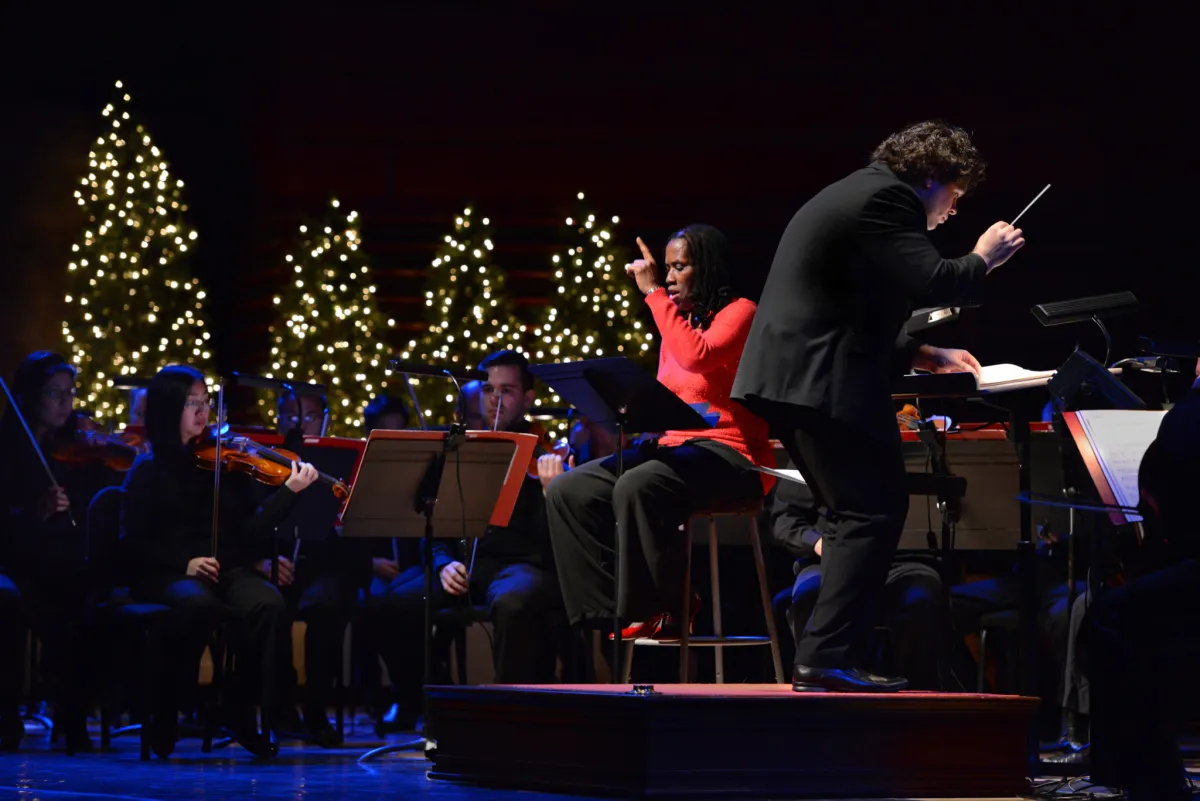 Photo: Philadelphia Orchestra, via i0.wp.com
Samuel Hartwell had died three years earlier, taking with him a secret that had sustained him through forty years of poverty in rural Kentucky: he heard symphonies in his head, complete and perfect, and he had found a way to get them out.
Learning Music Without Learning Music
Born in 1901 in a one-room cabin in the Appalachian foothills, Samuel grew up in a world where music meant fiddles and banjos, church hymns and work songs. His family had no piano, no sheet music, no connection to the classical tradition. What they had was a battery-powered radio that occasionally picked up broadcasts from distant cities, and a boy who would sit transfixed when those broadcasts included orchestral music.
"He'd get this look on his face," his sister Martha remembered years later. "Like he was listening to something the rest of us couldn't hear."
Samuel's formal education ended at age twelve when his father died and he took over the family's small tobacco farm. But his musical education was just beginning. He had discovered that he could hold entire compositions in his memory after hearing them just once, and more remarkably, he could manipulate them—changing keys, adding instruments, creating variations that existed only in his imagination.
The Wire Recorder Revolution
Samuel's breakthrough came in 1947 when he saved enough money to buy a used wire recorder from a catalog. The device, primitive by today's standards, could capture hours of audio on thin steel wire. For Samuel, it became his compositional notebook, his orchestra, his connection to a musical world he could never formally enter.
His method was unlike anything in classical music history. He would hum entire symphonic movements into the recorder, switching between different vocal tones to represent different instrument sections. A low growl for the cellos, a whistle for the flutes, a nasal hum for the oboes. To an outsider, it sounded like the musical ramblings of an eccentric. To Samuel, it was a complete orchestral score.
Finding His Translators
The challenge was getting these musical ideas out of his head and onto paper. Samuel knew he needed help, but approaching classically trained musicians seemed impossible. Who would take seriously a tobacco farmer who claimed to compose symphonies?
His solution was as ingenious as his compositions. He began writing letters to music students at universities across the South, offering to pay them small amounts to "help with a musical project." He never claimed to be a composer in these letters—just a man with some musical ideas who needed assistance with notation.
The first student to respond was Margaret Chen, a graduate student at the University of Kentucky. When she arrived at Samuel's farm in 1951, she expected to spend an afternoon helping an amateur transcribe some folk songs. Instead, she heard something that would change her understanding of musical genius.
The Symphony in Room 3B
"He played me the wire recording of his first symphony," Margaret recalled decades later, "and I knew immediately that I was listening to something extraordinary. The harmonic structure was complex, the orchestration was sophisticated, and the emotional depth was unlike anything I'd encountered in my formal training."
Margaret spent the next three years visiting Samuel's farm every weekend, painstakingly transcribing his hummed compositions into traditional notation. She was joined by other students who became believers in Samuel's impossible project: a man with no formal training who somehow understood the architecture of symphonic music better than most conservatory graduates.
The work was slow and challenging. Samuel couldn't tell them what key he was humming in or explain his harmonic choices in technical terms. He could only play the recordings and trust that his collaborators would capture what he heard. Sometimes they would spend hours on a single measure, playing it back on Margaret's portable piano until Samuel nodded his approval.
The Long Wait for Recognition
By 1958, Samuel and his network of student collaborators had completed three full symphonies and several shorter orchestral pieces. The music was undeniably sophisticated—complex enough to challenge professional orchestras, emotionally rich enough to move audiences. But getting it performed seemed impossible.
Classical music in the 1950s was a closed world, dominated by established composers with impressive credentials. A self-taught farmer from Kentucky, no matter how talented, couldn't break through those barriers. Samuel submitted his scores to orchestras and competitions under pseudonyms, but the rejections piled up.
He died in 1959, believing his music would remain forever unheard beyond the small circle of students who had helped bring it to life.
The Philadelphia Discovery
The wire recordings found in Philadelphia belonged to Margaret Chen, who had donated them to the orchestra's archives before moving to California. When conductor Eugene Ormandy listened to the recordings in 1963, he immediately recognized their quality. The Philadelphia Orchestra premiered Samuel's First Symphony in 1964, twenty-three years after he had first hummed it into his wire recorder.
The audience's response was electric. Critics struggled to categorize music that combined the emotional directness of folk traditions with the structural sophistication of classical masters. Samuel's Second Symphony received its premiere at Carnegie Hall in 1967, earning a ten-minute standing ovation.
 Photo: Carnegie Hall, via c8.alamy.com
Redefining Musical Genius
Samuel Hartwell's story challenges everything we think we know about musical training and talent. He proved that the ability to create profound music doesn't require formal education, expensive instruments, or institutional approval. It requires only the ability to hear beauty and the determination to share it with the world.
Today, his three symphonies are performed regularly by orchestras around the world. Music schools study his compositions as examples of intuitive orchestration that follows emotional rather than academic logic. His wire recordings, preserved at the Smithsonian, remain a testament to the power of human creativity to transcend any limitation.
Samuel never learned to read music, but he taught the world something more important: that musical genius speaks its own language, and sometimes the most beautiful symphonies are the ones that refuse to follow the rules.