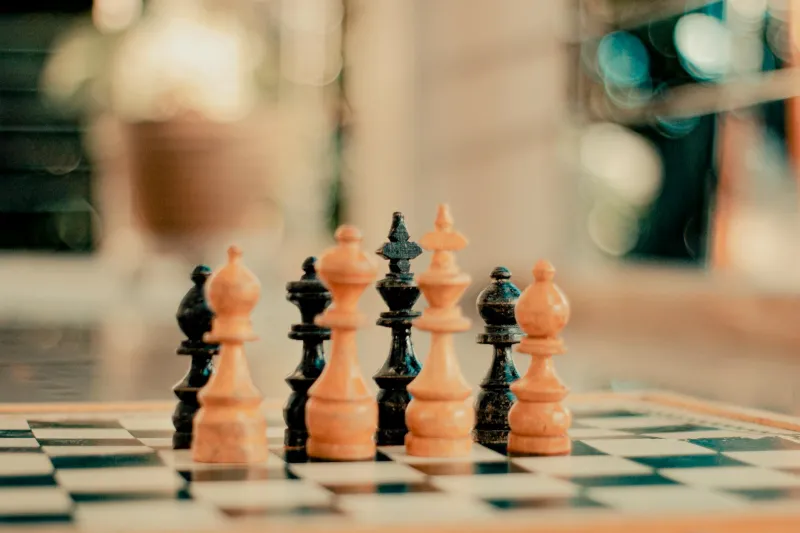
The Game That Existed Only in His Head
James Rodriguez learned chess on his third day in solitary confinement at Pelican Bay State Prison. Not from a book, not from another inmate, and certainly not from a chess set—none of those things were allowed in the isolation unit where he would spend the next four years of his life.
 Photo: Pelican Bay State Prison, via theprisondirect.com
He learned chess by reconstructing it piece by piece in his mind, starting with fragments of memory from a game he'd half-watched his uncle play decades earlier. In a 7-by-12-foot concrete cell with no windows and no human contact except for meal deliveries, Rodriguez began building what would become one of the most extraordinary chess educations in modern history.
"I had nothing but time and my own thoughts," Rodriguez recalls. "I figured I could either go crazy or get good at something. Chess seemed harder than going crazy."
Rodriguez was twenty-six when he entered prison in 1998, sentenced to fifteen years for armed robbery. He had a ninth-grade education, a history of substance abuse, and no experience with strategic thinking beyond the day-to-day survival tactics that had defined his life on the streets of East Los Angeles. Chess, the ancient game of kings and intellectuals, seemed as foreign to his world as quantum physics or opera.
 Photo: East Los Angeles, via cat-911.org
But in solitary, relevance became irrelevant. There was only the need to occupy a mind that otherwise had nowhere to go.
Building a Universe from Memory
Rodriguez began with what little he remembered: chess was played on a checkered board, pieces moved in different ways, and the goal was to trap the opponent's king. Beyond that, he was working from scratch.
Using techniques he developed himself, Rodriguez created a mental chessboard that he could visualize with perfect clarity. He assigned each square coordinates, memorized the starting position of every piece, and began teaching himself the basic rules through trial and error. When he made mistakes—which was constantly at first—he would reset his mental board and try again.
"I'd play games against myself for hours," he explains. "Left brain versus right brain, past me versus present me, whatever it took to create an opponent. Sometimes I'd imagine I was playing against famous people—Muhammad Ali, Einstein, my uncle who'd taught me those first moves."
The process was painstakingly slow. It took Rodriguez nearly six months to confidently remember how each piece moved. Another year to understand basic strategy concepts like controlling the center and protecting the king. But he had something that most chess students never get: unlimited time and zero distractions.
The Mental Gymnasium
By his second year in solitary, Rodriguez had developed routines that would have impressed cognitive scientists. He would wake up and "play" three games before breakfast, analyzing each move and considering alternatives. In the afternoon, he would work through chess problems he created for himself, setting up scenarios and finding solutions. At night, he would replay famous games from memory—games he'd never actually seen but had reconstructed from chess notation he'd memorized from magazines in the prison library during his brief pre-solitary period.
His cell became a laboratory for understanding the deepest patterns of chess. Without the ability to physically move pieces, Rodriguez was forced to think multiple moves ahead, to see the entire board as a dynamic system rather than a collection of individual pieces. He developed a visual memory so precise that he could recall the exact position of every piece from games he'd played weeks earlier.
"When you can't see anything, you learn to see everything," Rodriguez reflects. "I knew every square, every possible move, every pattern. The board lived in my head more clearly than anything in the real world."
The Test of Reality
When Rodriguez was finally released from solitary in 2002, he had been playing chess for four years without ever touching a physical piece. Prison officials allowed him to join the general population chess club, where inmates gathered twice a week to play on worn plastic sets.
His first game was against Miguel Santos, a lifer who had been the prison's unofficial chess champion for over a decade. Santos had learned chess from his father, had played in tournaments before his incarceration, and had defeated every challenger the prison could produce.
The game lasted thirty-seven moves. Rodriguez won.
"I'll never forget the look on Miguel's face," Rodriguez says. "He couldn't understand where I'd learned to play like that. When I told him I'd been practicing in my head for four years, he thought I was lying."
Word of Rodriguez's abilities spread quickly through the prison system. Inmates from other facilities requested transfers just to play against him. Chess masters on the outside began corresponding with him, sending him books and challenging him to postal games. In every case, the result was the same: Rodriguez won.
Freedom and Grandmasters
Rodriguez was released in 2013 after serving fifteen years. His first stop was a chess club in downtown Los Angeles, where he signed up for a tournament that included several nationally ranked players. He had never played speed chess, had never used a chess clock, and had never competed in a formal tournament setting.
He won the tournament without losing a single game.
Within two years of his release, Rodriguez had earned his Expert rating from the United States Chess Federation. Within five years, he had defeated two International Masters and was being coached by former world championship candidates. Today, at fifty-one, he teaches chess to at-risk youth and continues to compete at the highest levels of American chess.
"People ask me if I regret those years in prison," Rodriguez says. "I regret the choices that put me there, and I regret the pain I caused other people. But those four years in solitary? They gave me something I never could have found any other way. They taught me that the human mind is capable of things we can't even imagine."
The Lesson of Limitation
Rodriguez's story has been studied by cognitive scientists interested in the limits of human memory and visualization. His ability to play chess blindfolded—a skill that typically takes years to develop—emerged naturally from his circumstances. His strategic thinking, honed in isolation, reflects patterns that many grandmasters spend decades trying to understand.
But perhaps the most remarkable aspect of his story isn't the chess mastery itself, but what it reveals about the relationship between constraint and creativity. In a world that often equates freedom with opportunity, Rodriguez found that his greatest achievement came from his most restricted circumstances.
"When you take away everything external," he explains, "you discover what's actually inside you. For me, that turned out to be more than I ever knew was there."
Today, Rodriguez travels the country sharing his story with students, inmates, and anyone who believes their circumstances define their possibilities. His message is simple: the game is never over, and the most powerful moves often come from positions that look hopeless.
In a world where chess mastery typically requires expensive coaching, elite tournaments, and years of formal study, Rodriguez proved that sometimes the most profound education happens in the quietest places, with nothing but a willing mind and the patience to let it grow.