Six Feet Under, Sky Above: The Cemetery Worker Who Revolutionized Flight
The Sound of Shovels and Dreams
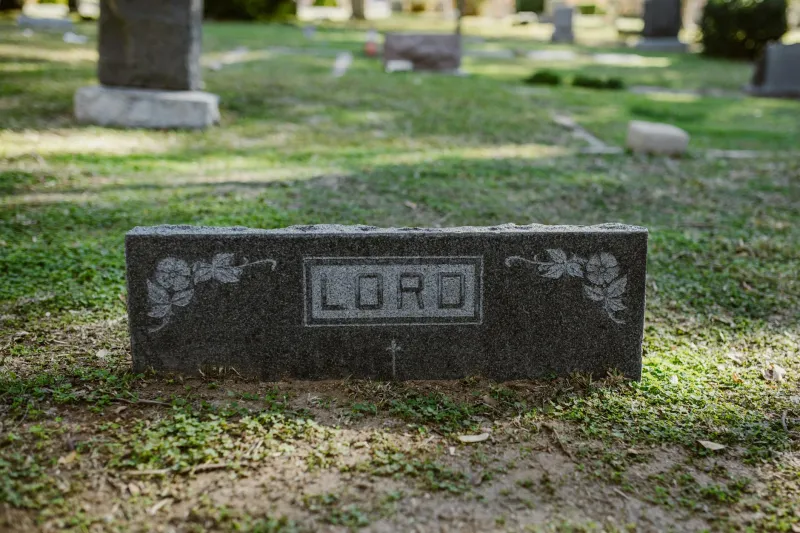
The red clay of Valdosta, Georgia stuck to everything in 1923—boots, clothes, and the dreams of young men with nowhere else to go. Charles Wesley Peters knew that clay intimately. For three years, he'd been digging graves at Sunset Hill Cemetery, six days a week, earning just enough to keep a roof over his head and food on his table. At twenty-four, with an eighth-grade education and hands permanently stained with Georgia earth, Peters seemed destined for a life measured in six-foot holes.
Then Jenny crashed into his world—literally.
When Heaven Falls to Earth
On a humid Tuesday morning in July, Peters was halfway through digging a grave when he heard the engine cough. He looked up to see a Curtiss JN-4 "Jenny" biplane sputtering across the sky, black smoke trailing behind it like a funeral shroud. The pilot was fighting for control, but physics had already won. The plane came down hard in the field adjacent to the cemetery, its wings crumpling like paper, its propeller snapping with a crack that echoed across the headstones.
Peters dropped his shovel and ran.
The pilot, a barnstormer named Jake Morrison, crawled from the wreckage with nothing worse than a bruised ego and a gash on his forehead. But as Peters helped him to his feet, something extraordinary happened. Instead of walking away from the twisted metal and fabric, Peters found himself drawn to it. While Morrison cursed his luck and radioed for a ride, Peters circled the wreckage like a detective studying a crime scene.
"What makes it fly?" he asked Morrison.
Morrison laughed. "Kid, if I knew that, I wouldn't be eating dirt right now."
The Education of a Gravedigger
But Peters wasn't joking. That night, he walked back to the crash site with a lantern and began taking the Jenny apart piece by piece. He had no manual, no training, no understanding of aerodynamics or mechanical engineering. He had only curiosity and the methodical patience that comes from spending years digging perfect holes.
What Peters found in that wreckage changed his life. The engine—a Curtiss OX-5—was a marvel of precision engineering, but it was also heavy, inefficient, and prone to failure. Peters saw problems everywhere he looked, but more importantly, he began to see solutions.
Over the following months, Peters transformed his small apartment into an unlikely laboratory. He salvaged parts from Morrison's crashed Jenny and began acquiring discarded aviation manuals from wherever he could find them—military surplus stores, junkyards, even trash bins behind aircraft manufacturing plants. He taught himself to read technical drawings by lamplight after twelve-hour days at the cemetery.
His landlord complained about the noise. His neighbors whispered about the strange contraptions appearing in his yard. But Peters kept working, driven by a vision that seemed impossible for a man who had never been more than fifty miles from his birthplace.
The Weight of Innovation
By 1925, Peters had identified what he believed was the fundamental flaw in early aircraft engines: they were too heavy for the power they produced. The Curtiss OX-5, for example, weighed nearly 400 pounds but generated only 90 horsepower. Peters became obsessed with the idea of creating a lighter, more efficient engine component that could revolutionize aviation.
Working with scrap metal and tools borrowed from a sympathetic blacksmith, Peters began designing what he called his "featherweight manifold"—an intake system that weighed sixty percent less than conventional designs while actually improving engine performance. The breakthrough came from an unlikely source: his experience with cemetery drainage systems had taught him how to move fluids efficiently through confined spaces.
From Graves to Glory
Peters' innovation caught the attention of a small aircraft manufacturer in Atlanta, who agreed to test his manifold design on their experimental aircraft. The results were remarkable—the plane showed improved fuel efficiency and better high-altitude performance while carrying significantly less weight.
Word spread through aviation circles about the gravedigger from Valdosta who had solved a problem that had stumped trained engineers. By 1927, Peters had left the cemetery forever, hired as a consultant by Wright Aeronautical Corporation. His lightweight manifold design became standard equipment on many aircraft throughout the 1930s and influenced engine development for decades to come.
The Sky's the Limit
Peters never learned to fly—he was afraid of heights, a irony not lost on his colleagues. But his contributions to aviation extended far beyond that single innovation. He held seventeen patents by the time he retired in 1952, including designs for improved fuel injection systems and engine cooling mechanisms.
The man who once measured his days in graves dug would eventually measure his legacy in lives saved. Aircraft equipped with Peters' innovations flew safer and farther than their predecessors, carrying passengers and cargo across distances that seemed impossible just decades earlier.
Six Feet Deep, Sky High
Charles Wesley Peters died in 1961, at age sixty-two, in a comfortable home in Dayton, Ohio—a long way from the red clay of Valdosta. His obituary in Aviation Week called him "the unlikely genius who proved that innovation knows no classroom." But perhaps the most fitting tribute came from a former colleague who said, "Charlie spent his early years six feet underground, but he spent the rest of his life helping humanity reach for the stars."
In a field dominated by college-educated engineers and military-trained pilots, Peters proved that extraordinary achievement could emerge from the most ordinary circumstances. His story reminds us that the next great breakthrough might come not from the ivory tower or the corporate laboratory, but from someone willing to look at familiar problems with completely fresh eyes.
Sometimes the most improbable journeys begin not with a leap, but with the simple act of looking up from whatever hole you're digging and daring to dream of flight.